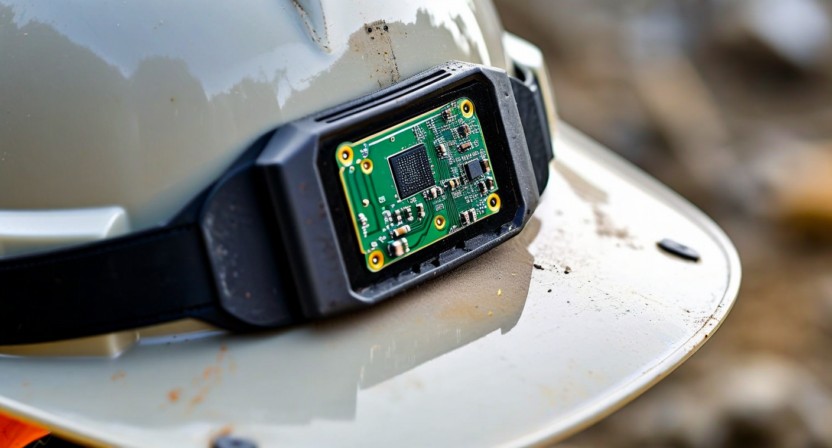
The math on construction site safety observation is straightforward and consistently ignored. A commercial jobsite with 200 workers operating two shifts daily gets, on average, 2-3 safety officer walk-throughs per shift. Each walk-through covers the site in 45-60 minutes and provides a safety officer's observation of conditions at a specific point in time. Total observation time per day: 3-4.5 hours. Total site operating time per day: 16-20 hours. The fraction of site operating time under active human safety observation: 18-22%.
The remaining 78-82% of operating time is observed only by the workers themselves and whatever foremen are managing their specific work activities. That's the window where most incidents happen, because it's the window that constitutes most of the workday. Closing that window — or substantially narrowing it — is the primary value proposition for continuous machine monitoring.
Why the spot inspection model persists despite its obvious limitations
The safety officer walk-through model dates to a period when it was the only practical option. Continuous human observation of a 10-acre construction site with 200 workers requires a prohibitive number of observers — roughly 15-20 safety personnel if you want one observer per 10 workers per shift, a staffing level that exists only at nuclear facility construction projects with specific regulatory requirements.
The model persists because it has real value beyond its observation coverage — it's also a teaching and reinforcement opportunity. A safety officer walking a site and stopping to correct a PPE violation teaches the worker directly and signals to nearby workers that compliance is monitored. That behavioral reinforcement effect is not replicated by a remote alert on a supervisor's mobile device. The spot inspection model's real strength is behavioral influence, not detection coverage.
Machine monitoring doesn't replace the behavioral influence function of human safety observation. It replaces the detection function — identifying PPE violations, zone breaches, and proximity hazards. The hybrid model that works in practice: machine monitoring provides continuous detection and alert generation; human safety officers use their walk-through time for enforcement, teaching, and contextual assessment rather than searching for violations. The machine finds the problems; the human responds and addresses them.
When hazards form relative to when they're observed
The timing of hazard formation matters for understanding why the observation gap causes incidents. Some construction hazards are persistent: an unguarded floor opening that formed when the hole was cut remains until it's covered or barricaded. A safety officer walk-through that happens 4 hours after the hole was cut still finds it. That category of hazard is reasonably detectable by spot inspections if the inspection frequency is adequate.
Other hazards are transient: a PPE non-compliance event that lasts 90 seconds while a worker removes a hot hard hat and replaces it 3 hours before the next inspection is invisible to spot checks. A worker who enters a crane swing radius during a lift, stays for 45 seconds while retrieving a dropped tool, and exits before any observer notices is also invisible. These transient hazards are exactly the scenarios that contribute disproportionately to serious injuries — because the hazard exists precisely when work activity is highest and workers are focused on their tasks, not on their compliance status.
Our Houston pilot data showed that 67% of PPE non-compliance events lasted less than 5 minutes. These events would be undetectable in 98%+ of spot inspections. A continuous monitoring system detected all of them. That detection capability doesn't mean 67% of compliance events cause incidents — most don't. But it does mean that without continuous monitoring, a site has essentially no data on the majority of its compliance events, and therefore no ability to identify workers, tasks, or zones with disproportionately high non-compliance rates.
The supervisor-to-worker ratio problem
OSHA's 29 CFR 1926.20(b)(2) requires that a "competent person" perform frequent and regular inspections, but does not specify a ratio of safety personnel to workers. Industry practice has converged on roughly 1 safety officer per 25-50 workers on commercial projects, with the ratio varying based on project complexity and owner requirements. At the low end of that range (1:50), one safety officer cannot provide meaningful real-time detection across 50 workers on a multi-level site during a single shift.
Machine monitoring expands the effective observation ratio without proportional staffing cost. In our deployment model, the 48-camera edge system provides continuous observation coverage equivalent to what 3-4 dedicated safety observers would provide if positioned optimally around the site — but without the fatigue factor (human observers become less effective after 2-3 hours of continuous attention) and without the need to physically move between observation points.
The result is that a site safety officer's attention can be focused on incidents that require human judgment and response rather than allocated to visual scanning. An experienced safety officer who spends their shift responding to machine-detected events — investigating, documenting, coaching workers — is more effective than the same officer spending 60% of their shift on walk-throughs that catch the visible, persistent hazards while missing the transient ones.
The observer fatigue problem
Human observers fatigue. After 90-120 minutes of continuous safety monitoring — watching a site, looking for compliance violations, scanning for hazard conditions — detection accuracy drops measurably. Vigilance research in aviation and process control shows detection rates declining 15-25% after the first hour of continuous monitoring, with further declines over subsequent hours. Construction safety observation is a vigilance task; the same fatigue dynamics apply.
Camera systems don't fatigue. A YOLOv8 model running frame inference at 15fps processes frame 150,000 with the same parameters as frame 1. There's no attention drift, no boredom, no mental fatigue from watching an active site for 8 hours. The detection accuracy in hour 8 is statistically identical to hour 1.
This is not a case for eliminating human safety officers — it's a case for deploying them where human judgment is required and machines for where consistent detection is required. Those are different tasks that benefit from different types of attention.
The compounding problem: unobserved time is disproportionately risky
There's evidence suggesting that unobserved periods carry disproportionate incident risk. The Hawthorne effect — workers behaving more safely when they know they're being observed — is well-documented in construction settings. If workers are safer during observation periods and less safe during unobserved periods, then the 78-82% of operating time without human observation contains more than 78-82% of the incident risk. The unobserved window may be responsible for 85-90% of incident risk while representing 78-82% of operating time.
This matters because it means the marginal safety value of the first hours of continuous monitoring — extending coverage from 22% of the day to 50% of the day — is higher than linear interpolation would suggest. The highest-risk periods are likely to be in the unobserved windows, and machine monitoring that covers those windows addresses disproportionately risky time rather than proportionately risky time.
For a technical discussion of how detection rate under different operating conditions affects overall coverage quality, see our article on PPE detection accuracy on active jobsites. To discuss coverage planning for a specific site configuration, contact us at contact@hardhatpulse.com.